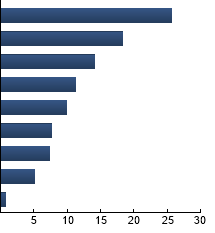
* Excluding cash. Holdings are subject to change.
*Performance data quoted represents past performance. Past performance is not a guarantee of future results and current performance may be higher or lower than performance quoted. Investment returns and principal value will fluctuate and shares when sold or redeemed, may be worth more or less than their original cost.
After Tax Held returns represent return after taxes on distributions. Assumes shares have not been sold. After Tax Sold returns represent the return after taxes on distributions and the sale of fund shares. Returns do not represent the returns you would receive if you traded shares at other times. Market Price returns are determined by using the midpoint of the national best bid offer price ("NBBO") as of the time that the fund's NAV is calculated. Returns are average annualized total returns, except those for periods of less than one year, which are cumulative.
After-tax returns are calculated using the historical highest individual federal marginal income tax rates and do not reflect the impact of state and local taxes. Actual after-tax returns depend on the investor’s tax situation and may differ from those shown. The after-tax returns shown are not relevant to investors who hold their fund shares through tax-deferred arrangements such as 401(k) plans or individual retirement accounts.
**Performance information for each listed index is for illustrative purposes only and does not represent actual fund performance. Indexes do not charge management fees or brokerage expenses, and no such fees or expenses were deducted from the performance shown. Indexes are unmanaged and an investor cannot invest directly in an index.
On March 4, 2024, the fund's underlying index changed from the Nasdaq Riskalyze US Large Cap™ Index to the Bloomberg Shareholder Yield Index. Therefore, the fund's performance and historical returns shown for the periods prior to this date are not necessarily indicative of the performance that the fund, based on its current index, would have generated.
Nasdaq Riskalyze US Large Cap™ Index - The Index is a modified market capitalization weighted index which seeks to provide a diversified portfolio of dividend-paying US large cap securities.
S&P 500® Index - The Index is an unmanaged index of 500 companies used to measure large-cap U.S. stock market performance.
You should consider the fund's investment objectives, risks, and charges and expenses carefully before investing. You can download a prospectus or summary prospectus, or contact First Trust Portfolios L.P. at 1-800-621-1675 to request a prospectus or summary prospectus which contains this and other information about the fund. The prospectus or summary prospectus should be read carefully before investing.
You could lose money by investing in a fund. An investment in a fund is not a deposit of a bank and is not insured or guaranteed. There can be no assurance that a fund's objective(s) will be achieved. Investors buying or selling shares on the secondary market may incur customary brokerage commissions. Please refer to each fund's prospectus and Statement of Additional Information for additional details on a fund's risks. The order of the below risk factors does not indicate the significance of any particular risk factor.
Unlike mutual funds, shares of the fund may only be redeemed directly from a fund by authorized participants in very large creation/redemption units. If a fund's authorized participants are unable to proceed with creation/redemption orders and no other authorized participant is able to step forward to create or redeem, fund shares may trade at a premium or discount to a fund's net asset value and possibly face delisting and the bid/ask spread may widen.
Current market conditions risk is the risk that a particular investment, or shares of the fund in general, may fall in value due to current market conditions. For example, changes in governmental fiscal and regulatory policies, disruptions to banking and real estate markets, actual and threatened international armed conflicts and hostilities, and public health crises, among other significant events, could have a material impact on the value of the fund's investments.
A fund is susceptible to operational risks through breaches in cyber security. Such events could cause a fund to incur regulatory penalties, reputational damage, additional compliance costs associated with corrective measures and/or financial loss.
Companies that issue dividend-paying securities are not required to continue to pay dividends on such securities. Therefore, there is a possibility that such companies could reduce or eliminate the payment of dividends in the future.
Equity securities may decline significantly in price over short or extended periods of time, and such declines may occur in the equity market as a whole, or they may occur in only a particular country, company, industry or sector of the market.
An index fund will be concentrated in an industry or a group of industries to the extent that the index is so concentrated. A fund with significant exposure to a single asset class, or the securities of issuers within the same country, state, region, industry, or sector may have its value more affected by an adverse economic, business or political development than a broadly diversified fund.
A fund may be a constituent of one or more indices or models which could greatly affect a fund's trading activity, size and volatility.
There is no assurance that the index provider or its agents will compile or maintain the index accurately. Losses or costs associated with any index provider errors generally will be borne by a fund and its shareholders.
As inflation increases, the present value of a fund's assets and distributions may decline.
Information technology companies are subject to certain risks, including rapidly changing technologies, short product life cycles, fierce competition, aggressive pricing and reduced profit margins, loss of patent, copyright and trademark protections, cyclical market patterns, evolving industry standards and regulation and frequent new product introductions.
Large capitalization companies may grow at a slower rate than the overall market.
Market risk is the risk that a particular security, or shares of a fund in general may fall in value. Securities are subject to market fluctuations caused by such factors as general economic conditions, political events, regulatory or market developments, changes in interest rates and perceived trends in securities prices. Shares of a fund could decline in value or underperform other investments as a result. In addition, local, regional or global events such as war, acts of terrorism, spread of infectious disease or other public health issues, recessions, natural disasters or other events could have significant negative impact on a fund.
A fund faces numerous market trading risks, including the potential lack of an active market for fund shares due to a limited number of market makers. Decisions by market makers or authorized participants to reduce their role or step away in times of market stress could inhibit the effectiveness of the arbitrage process in maintaining the relationship between the underlying values of a fund's portfolio securities and a fund's market price.
Mid capitalization companies may experience greater price volatility than larger, more established companies.
An index fund's return may not match the return of the index for a number of reasons including operating expenses, costs of buying and selling securities to reflect changes in the index, and the fact that a fund's portfolio holdings may not exactly replicate the index.
A fund and a fund's advisor may seek to reduce various operational risks through controls and procedures, but it is not possible to completely protect against such risks. The fund also relies on third parties for a range of services, including custody, and any delay or failure related to those services may affect the fund's ability to meet its objective.
A fund that invests in securities included in or representative of an index will hold those securities regardless of investment merit and the fund generally will not take defensive positions in declining markets.
High portfolio turnover may result in higher levels of transaction costs and may generate greater tax liabilities for shareholders.
The market price of a fund's shares will generally fluctuate in accordance with changes in the fund's net asset value ("NAV") as well as the relative supply of and demand for shares on the exchange, and a fund's investment advisor cannot predict whether shares will trade below, at or above their NAV.
Trading on an exchange may be halted due to market conditions or other reasons. There can be no assurance that a fund's requirements to maintain the exchange listing will continue to be met or be unchanged.
First Trust Advisors L.P. (FTA) is the adviser to the First Trust fund(s). FTA is an affiliate of First Trust Portfolios L.P., the distributor of the fund(s).
"Bloomberg®" and the indices licensed herein (the "Indices") are service marks of Bloomberg Finance L.P. and its affiliates, including Bloomberg Index Services Limited ("BISL"), the administrator of the Indices (collectively, "Bloomberg") and have been licensed for use for certain purposes by First Trust Advisors L.P. (the "Licensee"). Bloomberg is not affiliated with the Licensee, and Bloomberg does not approve, endorse, review, or recommend the financial products referenced herein (the "Financial Products"). Bloomberg does not guarantee the timeliness, accurateness, or completeness of any data or information relating to the Indices or the Financial Products.
CUSIP identifiers have been provided by CUSIP Global Services, managed on behalf of the American Bankers Association by FactSet Research Systems Inc. and are not for use or dissemination in a manner that would serve as a substitute for any CUSIP service. The CUSIP Database, ©2026 CUSIP Global Services. "CUSIP" is a registered trademark of the American Bankers Association.