|
|
 |
|
Investment Objective/Strategy - The First Trust Bloomberg Space Economy ETF (the "Fund") seeks investment results that correspond generally to the price and yield (before the Fund's fees and expenses) of an equity index called the Bloomberg Space Economy Index (the "Index"). Under normal market conditions, the Fund will invest at least 80% of its net assets (plus any borrowings for investment purposes) in the securities that comprise the Index. The Fund, using an indexing investment approach, attempts to replicate, before fees and expenses, the total return performance of the Index, which includes dividends paid by the securities in the Index. The Fund will generally employ a full replication strategy, meaning that it will normally invest in all of the securities comprising the Index in proportion to the weightings in the Index. The Index is developed, maintained, and sponsored by Bloomberg Index Services Limited (the "Index Provider").
There can be no assurance that the Fund's investment objectives will be achieved.
- The Bloomberg Space Economy Index is constructed to track the performance of companies that are exposed to space utilizing data from Bloomberg Intelligence (BI).
- The index begins with a universe of all the securities comprising the Bloomberg World Aggregate Universe, which tracks the top 99% of available free-float market capitalization across 47 developed and emerging market countries.
- Each company must belong to at least one or more of the following space economy exposure categories, as determined by BI:
- Space Domain Awareness: Companies providing detection, tracking and characterization of threats in space.
- Launch & Space Transportation: Companies manufacturing rockets, launch infrastructure and rocket components.
- Satellites & Communications: Companies deploying, operating, and maintaining satellite constellations.
- Space Data & Artificial Intelligence: Companies leveraging satellite constellations, advanced sensors and AI-driven analytics to generate information from space-based data.
- A company must also meet the size, liquidity and exchange requirements of the index. Only one security per issuer may be included.
- BI analysts assess each company across two independent measures:
- The Revenue Assessment scores each company’s current and potential near-term (3-5 year) revenue exposure to space on a scale of 1 to 3, where a score of 1 reflects more than 50% of a company’s total revenue is tied to or expected to be tied to space, a score of 2 reflects 20-50%, and a score of 3 reflects less than 20%.
- The Theme Assessment scores each company’s competitive positioning and ability to execute within the space economy on a scale of 1 to 3, where a score of 1 reflects the highest exposure to the space economy and a score of 3 reflects the lowest exposure. This assessment draws on BI analyst expertise, production capacity, capital allocation trends, customer relationships and access to capital.
- Companies with a combined Revenue Assessment and Theme Assessment score between 2 and 5 are assigned to either the Gold or Silver Tier and are eligible for index inclusion. Companies with higher combined scores are assigned to the Bronze Tier and are not eligible for inclusion.
- From the list of eligible Gold Tier companies, securities are selected first by Revenue Assessment and then by descending free-float market capitalization.
- Gold Tier companies with a Revenue Assessment of 1 are selected first, followed by Gold Tier companies with Revenue Assessments of 2 and 3.
- If fewer than 50 securities are selected, eligible Silver Tier companies are added using the same approach.
- The index selects up to 50 securities defined as “Space Economy Companies.”
- The index uses a modified market capitalization weighting approach, which adjusts each company’s market capitalization based on its Revenue Assessment score and issuer free-float market capitalization.
- Gold Tier securities are capped at 4.5%; Silver Tier at 3.0%; no security may have a weight below 0.10%.
- The index is rebalanced and reconstituted quarterly.
| Ticker | FSPC |
| Fund Type | Industrials |
| Investment Advisor | First Trust Advisors L.P. |
| Investor Servicing Agent | Bank of New York Mellon Corp |
| CUSIP | 33734X697 |
| ISIN | US33734X6976 |
| Fiscal Year-End | 09/30 |
| Exchange | NYSE Arca |
| Inception | 7/8/2026 |
| Inception Price | $19.58 |
| Inception NAV | $19.58 |
| Rebalance Frequency | Quarterly |
| Total Expense Ratio* | 0.65% |
* As of 7/9/2026
| Closing NAV1 | $18.28 |
| Closing Market Price2 | $18.28 |
| Bid/Ask Midpoint | $18.29 |
| Bid/Ask Premium | 0.05% |
| 30-Day Median Bid/Ask Spread3 | 0.32% |
| Total Net Assets | $1,827,873 |
| Outstanding Shares | 100,002 |
| Daily Volume | 297 |
| Average 30-Day Daily Volume | 1,419 |
| Closing Market Price 52-Week High/Low | $21.16 / $18.03 |
| Closing NAV 52-Week High/Low | $21.09 / $18.02 |
| Number of Holdings (excluding cash) | 50 |
| Holding |
Percent |
| Space Exploration Technologies Corp. (Class A) |
5.30% |
| Mitsubishi Heavy Industries, Ltd. |
5.27% |
| Palantir Technologies Inc. (Class A) |
5.12% |
| EchoStar Corporation (Class A) |
4.93% |
| Thales S.A. |
4.55% |
| Safran S.A. |
4.48% |
| Northrop Grumman Corporation |
4.43% |
| ViaSat, Inc. |
4.37% |
| L3Harris Technologies, Inc. |
3.96% |
| Rocket Lab Corporation |
3.67% |
* Excluding cash.
Holdings are subject to change.
Past performance is not indicative of future results.
| Maximum Market Cap. | $2,047,596 |
| Median Market Cap. | $9,037 |
| Minimum Market Cap. | $437 |
| Price/Earnings | 26.82 |
| Price/Book | 4.44 |
| Price/Cash Flow | 19.36 |
| Price/Sales | 2.79 |
| Country |
Percent |
| United States |
59.13% |
| France |
9.22% |
| Japan |
8.19% |
| South Korea |
3.63% |
| The Netherlands |
3.04% |
| Italy |
2.96% |
| Spain |
2.95% |
| Germany |
2.84% |
| Canada |
2.17% |
| United Kingdom |
1.93% |
|
|
2025 |
Q1 2026 |
Q2 2026 |
Q3 2026 |
| Days Traded at Premium |
--- |
--- |
--- |
53 |
| Days Traded at Discount |
--- |
--- |
--- |
6 |
|
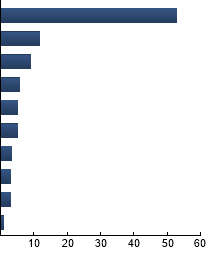
Aerospace & Defense
|
52.93%
|
|
Diversified Telecommunication Services
|
11.84%
|
|
Machinery
|
8.97%
|
|
Media
|
5.58%
|
|
Communications Equipment
|
5.20%
|
|
Software
|
5.13%
|
|
Professional Services
|
3.26%
|
|
Industrial Conglomerates
|
3.10%
|
|
IT Services
|
2.95%
|
|
Electrical Equipment
|
1.04%
|
|
|
Tracking Index: Bloomberg Space Economy Index
MSCI ACWI Index - The Index is a free float-adjusted market capitalization-weighted index that is designed to measure the equity market performance of developed and emerging markets.
|
|
The information presented is not intended to constitute an investment recommendation for, or advice to, any specific person. By providing this information, First Trust is not undertaking to give advice in any fiduciary capacity within the meaning of ERISA, the Internal Revenue Code or any other regulatory framework. Financial professionals are responsible for evaluating investment risks independently and for exercising independent judgment in determining whether investments are appropriate for their clients.
|