First Trust Bloomberg Space Economy ETF (FSPC)
Investment Objective/Strategy - The First Trust Bloomberg Space Economy ETF (the "Fund") seeks investment results that correspond generally to the price and yield (before the Fund's fees and expenses) of an equity index called the Bloomberg Space Economy Index (the "Index"). Under normal market conditions, the Fund will invest at least 80% of its net assets (plus any borrowings for investment purposes) in the securities that comprise the Index. The Fund, using an indexing investment approach, attempts to replicate, before fees and expenses, the total return performance of the Index, which includes dividends paid by the securities in the Index. The Fund will generally employ a full replication strategy, meaning that it will normally invest in all of the securities comprising the Index in proportion to the weightings in the Index. The Index is developed, maintained, and sponsored by Bloomberg Index Services Limited (the "Index Provider").
There can be no assurance that the Fund's investment objectives will be achieved.
Index Description According to the Index Provider
  • The Bloomberg Space Economy Index is constructed to track the performance of companies that are exposed to space utilizing data from Bloomberg Intelligence (BI).
  • The index begins with a universe of all the securities comprising the Bloomberg World Aggregate Universe, which tracks the top 99% of available free-float market capitalization across 47 developed and emerging market countries.
  • Each company must belong to at least one or more of the following space economy exposure categories, as determined by BI:
    • Space Domain Awareness: Companies providing detection, tracking and characterization of threats in space.
    • Launch & Space Transportation: Companies manufacturing rockets, launch infrastructure and critical components.
    • Satellites & Communications: Companies deploying, operating, and maintaining satellite constellations.
    • Space Data & Artificial Intelligence: Companies leveraging satellite constellations, advanced sensors and AI-driven analytics to generate actionable intelligence from space-based data.
  • A company must also meet the size, liquidity and exchange requirements of the index. Only one security per issuer may be included.
  • BI analysts assess each company across two independent measures:
    • The Revenue Assessment scores each company’s current and potential near-term (3-5 year) revenue exposure to space on a scale of 1 to 3, where a score of 1 reflects more than 50% of a company’s total revenue is tied to space, a score of 2 reflects 20-50%, and a score of 3 reflects less than 20%.
    • The Theme Assessment scores each company’s competitive positioning and ability to execute within the space economy on a scale of 1 to 3, where a score of 1 reflects the highest exposure to the space economy and a score of 3 reflects the lowest exposure. This assessment draws on BI analyst expertise, production capacity, capital allocation trends, customer relationships and access to capital.
  • Companies with a combined Revenue Assessment and Theme Assessment score between 2 and 5 are assigned to either the Gold or Silver Tier and are eligible for index inclusion. Companies with higher combined scores are assigned to the Bronze Tier and are not eligible for inclusion.
  • From the list of eligible Gold Tier companies, securities are selected first by Revenue Assessment and then by descending free-float market capitalization.
    • Gold Tier companies with a Revenue Assessment of 1 are selected first, followed by Gold Tier companies with Revenue Assessments of 2 and 3.
    • If fewer than 50 securities are selected, eligible Silver Tier companies are added using the same approach.
  • The index selects up to 50 securities defined as “Space Economy Companies.”
  • The index uses a modified market capitalization weighting approach, which adjusts each company’s market capitalization based on its Revenue Assessment score and issuer free-float market capitalization.
    • Gold Tier securities are capped at 4.5%; Silver Tier at 3.0%; no security may have a weight below 0.10%.
  • The index is rebalanced and reconstituted quarterly.
Fund Overview
TickerFSPC
Fund TypeIndustrials
Investment AdvisorFirst Trust Advisors L.P.
Investor Servicing AgentBank of New York Mellon Corp
CUSIP33734X697
ISINUS33734X6976
Fiscal Year-End09/30
ExchangeNYSE Arca
Inception7/8/2026
Inception Price$19.58
Inception NAV$19.58
Rebalance FrequencyQuarterly
Total Expense Ratio*0.65%
* As of 7/9/2026
Current Fund Data (as of 7/8/2026)
Number of Holdings (excluding cash)49
Top Holdings (as of 7/8/2026)*
Holding Percent
ViaSat, Inc. 5.72%
Rocket Lab Corporation 5.64%
Safran S.A. 5.20%
Thales S.A. 3.93%
L3Harris Technologies, Inc. 3.75%
AST SpaceMobile, Inc. 3.71%
Airbus SE 3.59%
Mitsubishi Heavy Industries, Ltd. 3.59%
Planet Labs PBC (Class A) 3.54%
Northrop Grumman Corporation 3.51%

* Excluding cash.  Holdings are subject to change.

NAV History (Since Inception)
Chart Currently Not Available
Fund Characteristics (as of 7/8/2026)1
Maximum Market Cap.$316,973
Median Market Cap.$9,890
Minimum Market Cap.$535
Price/Book5.07
Price/Cash Flow19.23
Price/Sales3.00
Top Country Exposure (as of 7/8/2026)
Country Percent
United States 57.15%
France 10.09%
Japan 7.48%
South Korea 3.96%
The Netherlands 3.83%
Italy 3.64%
Canada 3.13%
Spain 3.03%
Germany 1.97%
United Kingdom 1.86%
Bid/Ask Premium/Discount (as of 7/8/2026)
Chart Currently Not Available
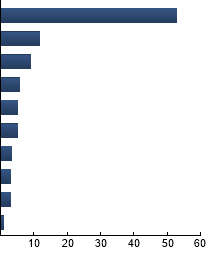
Top Industry Exposure (as of 7/8/2026)
Aerospace & Defense 59.78%
Machinery 8.71%
Diversified Telecommunication Services 7.09%
Communications Equipment 6.68%
Media 4.68%
Professional Services 4.29%
IT Services 3.03%
Software 2.89%
Industrial Conglomerates 1.54%
Electrical Equipment 1.31%
Footnotes
1 All market capitalization numbers are in USD$ Millions.

You should consider the fund's investment objectives, risks, and charges and expenses carefully before investing. You can download a prospectus or summary prospectus, or contact First Trust Portfolios L.P. at 1-800-621-1675 to request a prospectus or summary prospectus which contains this and other information about the fund. The prospectus or summary prospectus should be read carefully before investing.

Risk Considerations

You could lose money by investing in a fund. An investment in a fund is not a deposit of a bank and is not insured or guaranteed. There can be no assurance that a fund's objective(s) will be achieved. Investors buying or selling shares on the secondary market may incur customary brokerage commissions. Please refer to each fund's prospectus and Statement of Additional Information for additional details on a fund's risks. The order of the below risk factors does not indicate the significance of any particular risk factor.

The companies involved in the aerospace and defense industries are subject to fierce competition, consolidation, adverse political and government developments, substantial research and development costs, limited numbers of potential customers and excess capacity and spending trends. Their products and services may be subject to rapid obsolescence.

Artificial intelligence companies tend to be more volatile and they may have limited product lines, markets, financial resources or personnel and are subject to the risks of changes in business cycles, world economic growth, technological progress, costs of research and development, and government regulation. These companies are also heavily dependent on intellectual property rights, and challenges to or misappropriation of such rights could have a material adverse effect on such companies. Additionally, artificial intelligence technology could face increased regulatory scrutiny in the future, which may limit the development of this technology and impede the growth of companies that develop and/or utilize artificial intelligence.

Unlike mutual funds, shares of the fund may only be redeemed directly from a fund by authorized participants in very large creation/redemption units. If a fund's authorized participants are unable to proceed with creation/redemption orders and no other authorized participant is able to step forward to create or redeem, fund shares may trade at a premium or discount to a fund's net asset value and possibly face delisting and the bid/ask spread may widen.

Communication services companies are subject to certain risks, which may include rapidly changing technologies, short product life cycles, fierce competition, aggressive pricing and reduced profit margins, loss of patent, copyright and trademark protections, cyclical market patterns, evolving industry standards, often unpredictable changes in consumer tastes and frequent new product introductions. Such companies are particularly vulnerable to domestic and international government regulation, rely heavily on intellectual property rights, and may be adversely affected by the loss or impairment of those rights.

Changes in currency exchange rates and the relative value of non-US currencies may affect the value of a fund's investments and the value of a fund's shares.

Current market conditions risk is the risk that a particular investment, or shares of the fund in general, may fall in value due to current market conditions. For example, changes in governmental fiscal and regulatory policies, disruptions to banking and real estate markets, actual and threatened international armed conflicts and hostilities, and public health crises, among other significant events, could have a material impact on the value of the fund's investments.

A fund is susceptible to operational risks through breaches in cyber security. Such events could cause a fund to incur regulatory penalties, reputational damage, additional compliance costs associated with corrective measures and/or financial loss.

Depositary receipts may be less liquid than the underlying shares in their primary trading market and distributions may be subject to a fee. Holders may have limited voting rights, and investment restrictions in certain countries may adversely impact their value.

Investments in emerging market securities are generally considered speculative and involve additional risks relating to political, economic and regulatory conditions.

Equity securities may decline significantly in price over short or extended periods of time, and such declines may occur in the equity market as a whole, or they may occur in only a particular country, company, industry or sector of the market.

An index fund will be concentrated in an industry or a group of industries to the extent that the index is so concentrated. A fund with significant exposure to a single asset class, or the securities of issuers within the same country, state, region, industry, or sector may have its value more affected by an adverse economic, business or political development than a broadly diversified fund.

A fund may be a constituent of one or more indices or models which could greatly affect a fund's trading activity, size and volatility.

There is no assurance that the index provider or its agents will compile or maintain the index accurately. Losses or costs associated with any index provider errors generally will be borne by a fund and its shareholders.

Industrials and producer durables companies are subject to certain risks, including the general state of the economy, intense competition, consolidation, domestic and international politics, excess capacity and consumer demand and spending trends. They may also be significantly affected by overall capital spending levels, economic cycles, technical obsolescence, delays in modernization, labor relations, and government regulations.

Information technology companies are subject to certain risks, including rapidly changing technologies, short product life cycles, fierce competition, aggressive pricing and reduced profit margins, loss of patent, copyright and trademark protections, cyclical market patterns, evolving industry standards and regulation and frequent new product introductions.

A fund that holds securities that traded on non-U.S. exchanges that are closed when the fund's primary exchange is open, will likely experience deviations between the current price of a security and the last quoted foreign price from the closed foreign market. This can result in wider premiums or discounts to a fund's net asset value. Additionally, investors may be unable to trade fund shares on days when events in foreign markets could materially affect a fund's value.

Large capitalization companies may grow at a slower rate than the overall market.

Certain fund investments may be subject to restrictions on resale, trade over-the-counter or in limited volume, or lack an active trading market. Illiquid securities may trade at a discount and may be subject to wide fluctuations in market value.

Market risk is the risk that a particular security, or shares of a fund in general may fall in value. Securities are subject to market fluctuations caused by such factors as general economic conditions, political events, regulatory or market developments, changes in interest rates and perceived trends in securities prices. Shares of a fund could decline in value or underperform other investments as a result. In addition, local, regional or global events such as war, acts of terrorism, spread of infectious disease or other public health issues, recessions, natural disasters or other events could have significant negative impact on a fund.

A fund faces numerous market trading risks, including the potential lack of an active market for fund shares due to a limited number of market makers. Decisions by market makers or authorized participants to reduce their role or step away in times of market stress could inhibit the effectiveness of the arbitrage process in maintaining the relationship between the underlying values of a fund's portfolio securities and a fund's market price.

Mid capitalization companies may experience greater price volatility than larger, more established companies.

Large inflows and outflows may impact a new fund's market exposure for limited periods of time.

An index fund's return may not match the return of the index for a number of reasons including operating expenses, costs of buying and selling securities to reflect changes in the index, and the fact that a fund's portfolio holdings may not exactly replicate the index.

A fund classified as "non-diversified" may invest a relatively high percentage of its assets in a limited number of issuers. As a result, a fund may be more susceptible to a single adverse economic or regulatory occurrence affecting one or more of these issuers, experience increased volatility and be highly concentrated in certain issuers.

Securities of non-U.S. issuers are subject to additional risks, including currency fluctuations, political risks, withholding, lack of liquidity, lack of adequate financial information, and exchange control restrictions impacting non-U.S. issuers.

A fund and a fund's advisor may seek to reduce various operational risks through controls and procedures, but it is not possible to completely protect against such risks. The fund also relies on third parties for a range of services, including custody, and any delay or failure related to those services may affect the fund's ability to meet its objective.

A fund that invests in securities included in or representative of an index will hold those securities regardless of investment merit and the fund generally will not take defensive positions in declining markets.

The market price of a fund's shares will generally fluctuate in accordance with changes in the fund's net asset value ("NAV") as well as the relative supply of and demand for shares on the exchange, and a fund's investment advisor cannot predict whether shares will trade below, at or above their NAV.

Companies involved in the creation and utilization of space-related technologies face risks related to emerging technologies, evolving market demand, increased competition, and reliance on continued technological advancement. In addition, these companies may be affected by supply chain disruptions, cybersecurity incidents, regulatory changes, government spending and contracting policies, geopolitical events, labor shortages, and equipment obsolescence. As a result, investments in a fund focused on space economy companies may be more volatile and subject to greater risk than investments in more established industries.

Trading on an exchange may be halted due to market conditions or other reasons. There can be no assurance that a fund's requirements to maintain the exchange listing will continue to be met or be unchanged.

A fund may hold securities or other assets that may be valued on the basis of factors other than market quotations. This may occur because the asset or security does not trade on a centralized exchange, or in times of market turmoil or reduced liquidity. Portfolio holdings that are valued using techniques other than market quotations, including "fair valued" assets or securities, may be subject to greater fluctuation in their valuations from one day to the next than if market quotations were used. There is no assurance that a fund could sell or close out a portfolio position for the value established for it at any time.

First Trust Advisors L.P. (FTA) is the adviser to the First Trust fund(s). FTA is an affiliate of First Trust Portfolios L.P., the distributor of the fund(s).

"Bloomberg®" and the indices licensed herein (the "Indices") are service marks of Bloomberg Finance L.P. and its affiliates, including Bloomberg Index Services Limited ("BISL"), the administrator of the Indices (collectively, "Bloomberg") and have been licensed for use for certain purposes by First Trust Advisors L.P. (the "Licensee"). Bloomberg is not affiliated with the Licensee, and Bloomberg does not approve, endorse, review, or recommend the financial products referenced herein (the "Financial Products"). Bloomberg does not guarantee the timeliness, accurateness, or completeness of any data or information relating to the Indices or the Financial Products.

CUSIP identifiers have been provided by CUSIP Global Services, managed on behalf of the American Bankers Association by FactSet Research Systems Inc. and are not for use or dissemination in a manner that would serve as a substitute for any CUSIP service. The CUSIP Database, ©2026 CUSIP Global Services. "CUSIP" is a registered trademark of the American Bankers Association.

Not FDIC Insured • Not Bank Guaranteed • May Lose Value